Convert Emails into Review-Ready PDFs

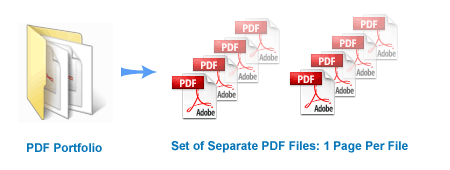
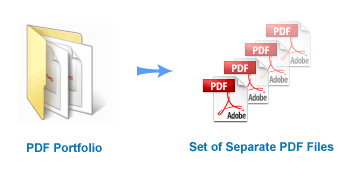
Turning PDF Portfolios into Regular PDF Documents

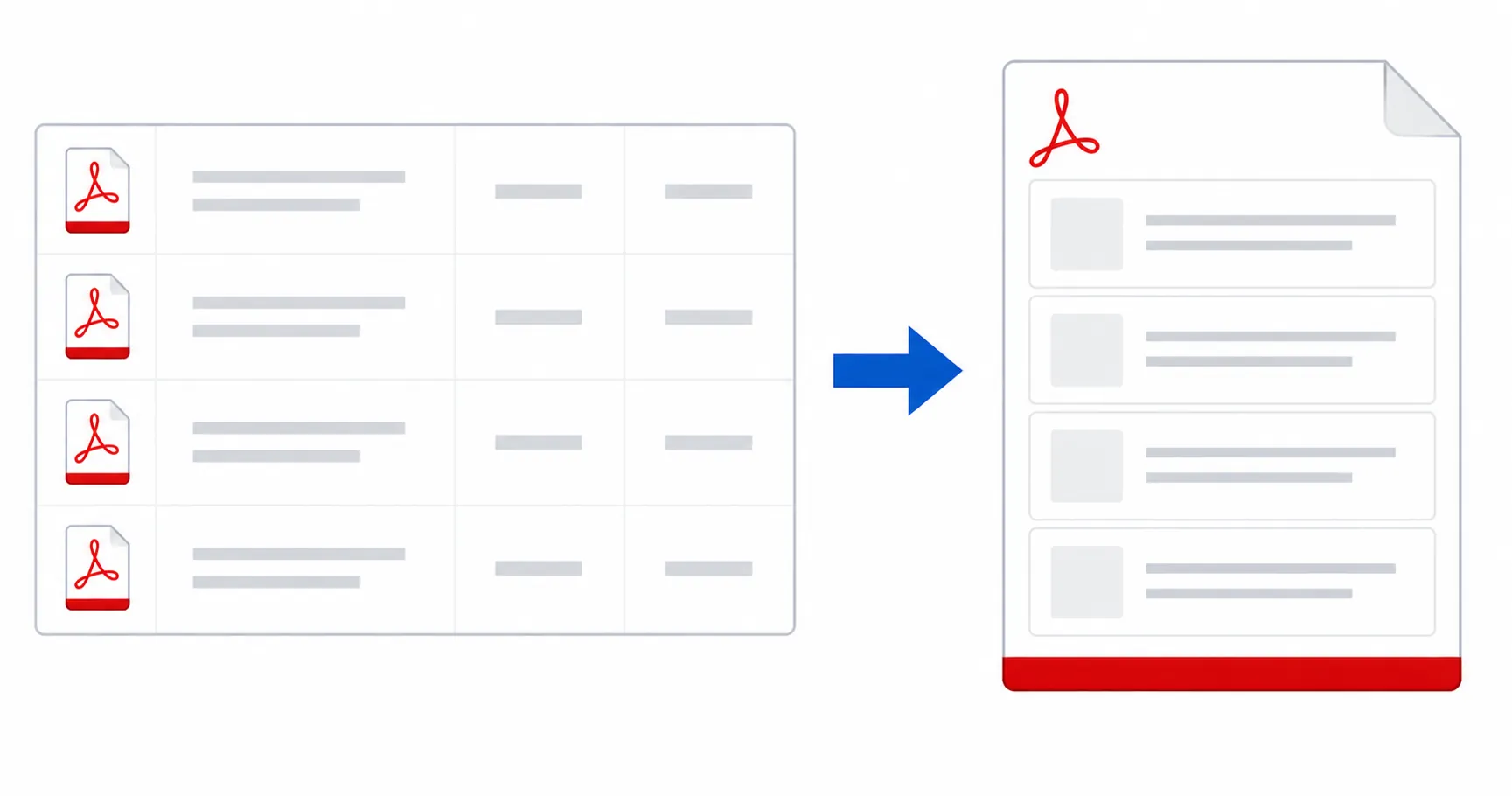
AutoPortfolio™ is a plug-in for Adobe® Acrobat® built for litigation support and e-discovery workflows. It converts emails and their attachments into review-ready PDFs — the kind of task paralegals and litigation support staff handle every day when preparing document productions.

Each email is converted into a single PDF, with every attachment converted to PDF and appended directly behind its parent email — so the full email "family" stays together, just as it would in a document production. You can choose to output each email and its attachments as its own individual PDF, or combine an entire batch of emails into one large PDF for review. Instead of manually opening, converting, and reassembling hundreds of emails and attachments by hand, AutoPortfolio handles the heavy lifting automatically.

Email to regular PDF conversion workflow with attachments appended

The software works directly with PDF Portfolios — the format commonly used to export and archive email collections from Microsoft Outlook, Gmail, Office 365, and other email platforms — making it a natural fit for processing email evidence and client correspondence ahead of review or production.

Email Conversion
The plug-in provides powerful functionality for managing emails stored in PDF portfolios:
  • Converting portfolios into regular PDF files
  • Extracting email file attachments and converting them into PDF format
  • Exporting email metadata into Excel and HTML formats
  • Converting portfolios for use in litigation support systems
  • De-duplication of PDF file collections
  • Converting EML files into PDF portfolio format
  • Check large PDF portfolios for corrupted PDF files
Litigation Tools

Tutorials

Step-by-Step Tutorials

Use cases

Built for real email workflows.

Convert Emails into Single PDF

Convert an email collection with document attachments such as MS Word, Excel, PDF into a single regular PDF.

Extract Emails with Attachments

Extract emails from PDF portfolio file with all file attachments converted to PDF as separate complete PDF files.

Export Email Metadata

Export complete email metadata from PDF portfolios such as From,To,CC,Subject,Sent into spreadhsheet format (CSV).

Export Bates Numbers

Exporting Bates numbers for a set of PDF files into a spreadsheet format (CSV).

Stamp Pages with Email Metadata

Watermark PDF pages with filenames and email metadata such as date or recipient.

Export to Litigation Support Systems

Export PDF portfolios into litigation support systems while extracting each page as a separate image file.

Deduplicate PDFs

Check a set of PDF files for duplicates and text contained in other documents.
Functionality Overview

Converting PDF Portfolios ↑top
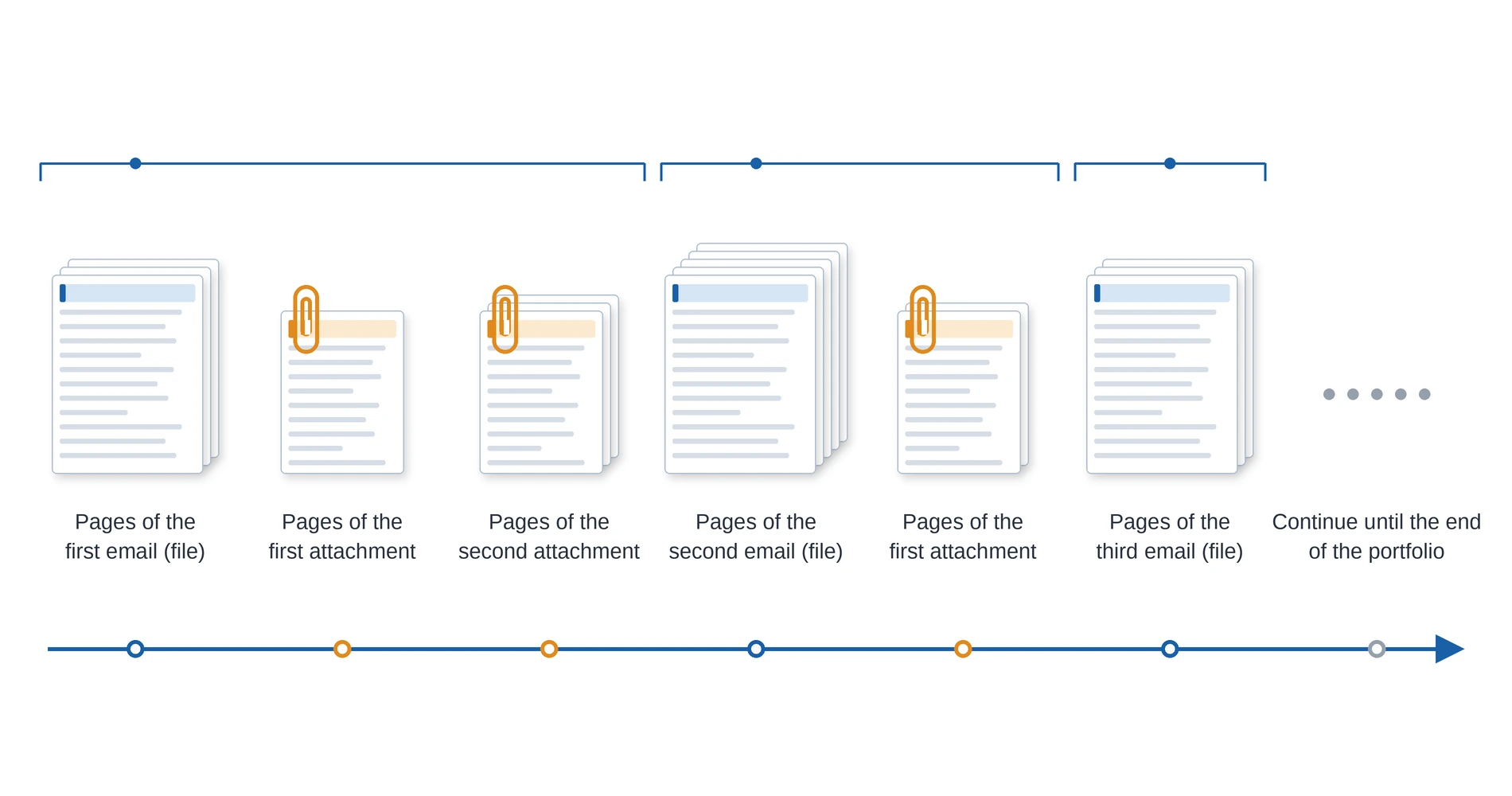
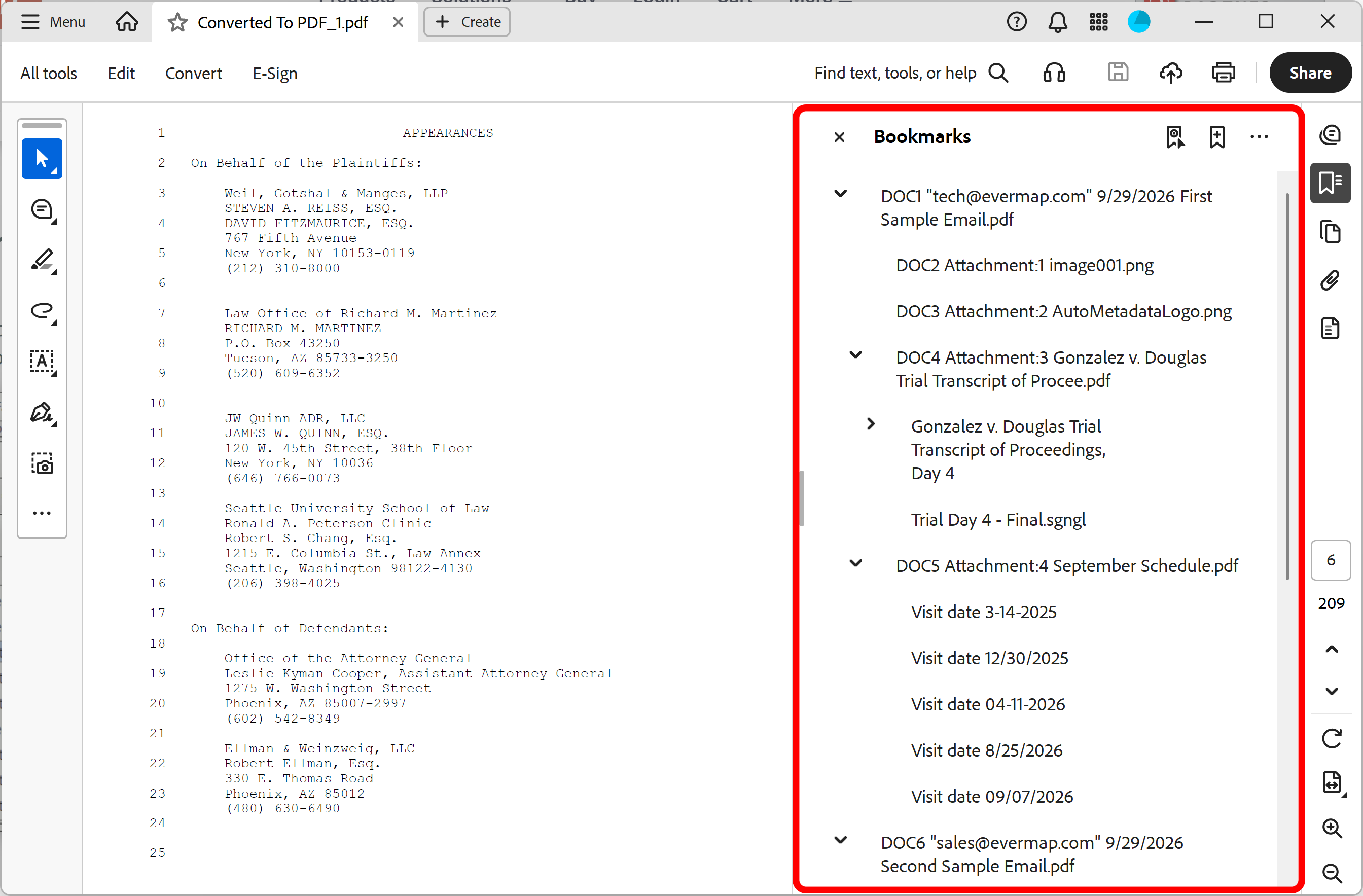
The plug-in provides the ability to convert the content of one or more PDF Portfolios into a single "flat" PDF document. All embedded files and corresponding file attachments are merged together to create a regular PDF file. The beginning of each file is bookmarked (with additional child bookmarks pointing to file attachments). Non-PDF file attachments are optionally converted into PDF format. Attachments are merged at the end of the parent document.
Convert PDF portfolio into regular PDF documents
The plug-in can merge regular PDF documents with their page-level file attachments. File attachments are optionally converted into PDF format and appended to the end of their parent document.
This operation is useful when it's necessary to apply Bates stamping to emails with non-PDF attachments. First, a portfolio with emails is converted into a single PDF document with attachments converted to PDF and appended to the end of the parent email. It is straightforward to stamp a single PDF document in Adobe Acrobat.
The following diagram shows the resulting page order in the converted PDF file:
Page order in the converted PDF file
Bookmarking Emails and Attachments ↑top
The plug-in bookmarks the first page of each portfolio item (email) and each of its attachments for easy navigation. Each top-level bookmark is named from the item's "Description" metadata field. If a PDF attachment already contains bookmarks, they are carried over into the output file and still point to the correct pages within that attachment. This preserves the original document navigation, so no structure is lost in the conversion.
Bookmarking emails and file attachments
Sorting and Filtering ↑top
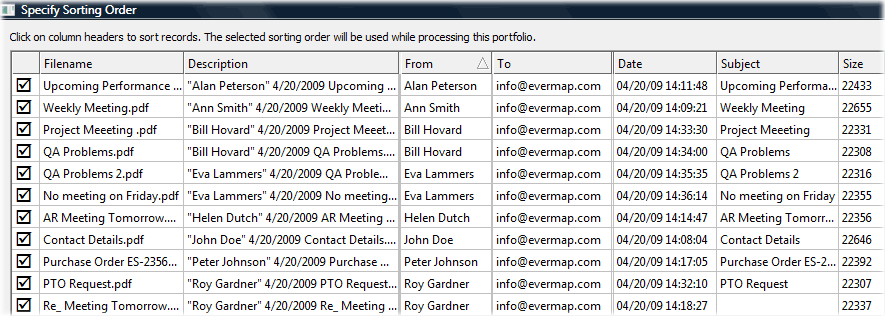
The software provides sorting and filtering capabilities (see screenshot below) based on the embedded files' metadata. For example, embedded files from a PDF Portfolio that contains emails can be sorted based on the date received (or any other metadata field such as "From", "To", or "Subject" etc.) and then merged into a single output file, producing a regular PDF with all emails organized in chronological order.
Sorting order
Processing of Multiple Files ↑top
The plug-in provides an option for creating either a single output document (or a set of files, depending on the operation) for one or more input PDF portfolios, or to create a separate output for each input portfolio (all output files are placed into automatically created sub-folders). The second option provides a powerful ability to batch process a large number of input PDF portfolios (email archives for example) into separate output documents. Each email archive is converted into a separate PDF file and placed into a separate folder.
Supported File Formats ↑top
The plug-in uses existing file conversion filters installed in your copy of Adobe Acrobat to convert non-PDF files into a PDF format. If Adobe Acrobat can create a PDF file from a certain file format, then the plug-in will be able to convert it as well. Some file formats require the presence of corresponding software products on the same computer. For example, you need Microsoft Office Word installed on your computer in order to convert Microsoft Word documents (*.doc) into PDF format.
Select Portfolio Items By Date ↑top
The plug-in also provides a simple interface for selecting portfolio items based on a date range. This is a very useful operation for processing large email archives. Use this method to process/extract/convert all emails received between two dates.
Selecting Portfolio Items By Search and Record Numbers ↑top
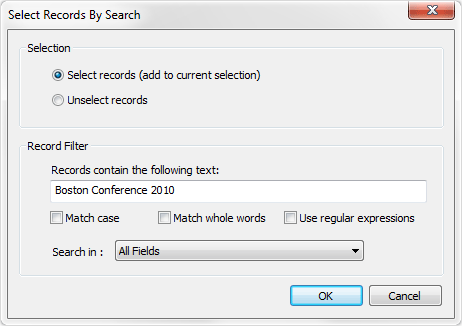
The plug-in provides a powerful "select by search" method for selecting only those documents from a PDF Portfolio that contain a specific text or pattern. Use this feature to process only files that have a certain word(s) in a specific metadata field(s). For example, select only emails from "John Adams" or with "QA Problems" in a subject line. Another useful selection method is by record numbers. This is useful when it's necessary to process a large portfolio in smaller increments .
Selecting emails by search
Processing ZIP File Attachments ↑top
The plug-in optionally extracts ZIP file attachments and converts all contained files into PDF. This capability makes handling ZIP file attachments completely transparent.
Processing MSG File Attachments ↑top
The plug-in extracts the content of MSG file attachments and converts them into PDF format on an individual basis (similar to the processing of ZIP archives). The MSG format is used by the Microsoft Outlook email program to save email messages as separate files.
Custom Processing using Acrobat JavaScript ↑top
The AutoPortfolio plug-in provides the ability to execute custom Acrobat JavaScript code on every PDF document contained in the input portfolio. Acrobat JavaScript is a scripting language of Adobe Acrobat that is based on widely-used JavaScript language.
Acrobat JavaScript code can be optionally run on:
  • All top-level entries in a PDF portfolio
  • All attachments that are in PDF format
  • All attachments that are converted into PDF format

The custom scripts can be used to perform a variety of tasks on PDF documents:
  • Adding custom text ("watermarks") to the document
  • Placing stamps and annotations
  • Adding cover pages by inserting pages from external PDF files
  • Performing document processing based on metadata fields
  • Saving documents into alternative locations
  • Embedding metadata into individual PDF files

Extract Embedded Files and Metadata

Extract Embedded Files ↑top
Use this software to extract all embedded files (including file attachments) from one or more PDF Portfolios. Non-PDF file attachments are optionally converted into PDF format. The plug-in automatically creates a Casemap load file (a text file that lists all extracted files) based on the user-defined sorting order. Sorting and filtering capabilities allow the export of all or only a few selected files based on any existing metadata field.
The plug-in can process regular PDF files with embedded files as well as PDF Portfolios (or PDF Packages). The HTML (with hyperlinks to extracted files) and CSV report files are generated automatically and include the following metadata: file name, description, size in bytes, creation and modification date/time, and MD5 checksum.
Extraction diagram
Create Custom File Names From Metadata ↑top
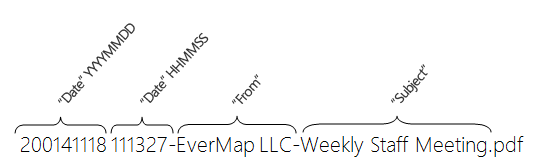
Use metadata information to rename files and attachments. Combine static text and metadata values to create informative file names. Here is an example of using "Date", "From" and "Subject" fields to create a custom file name suitable for easy sorting in Windows Explorer:
File renaming
Extract Portfolio Metadata ↑top
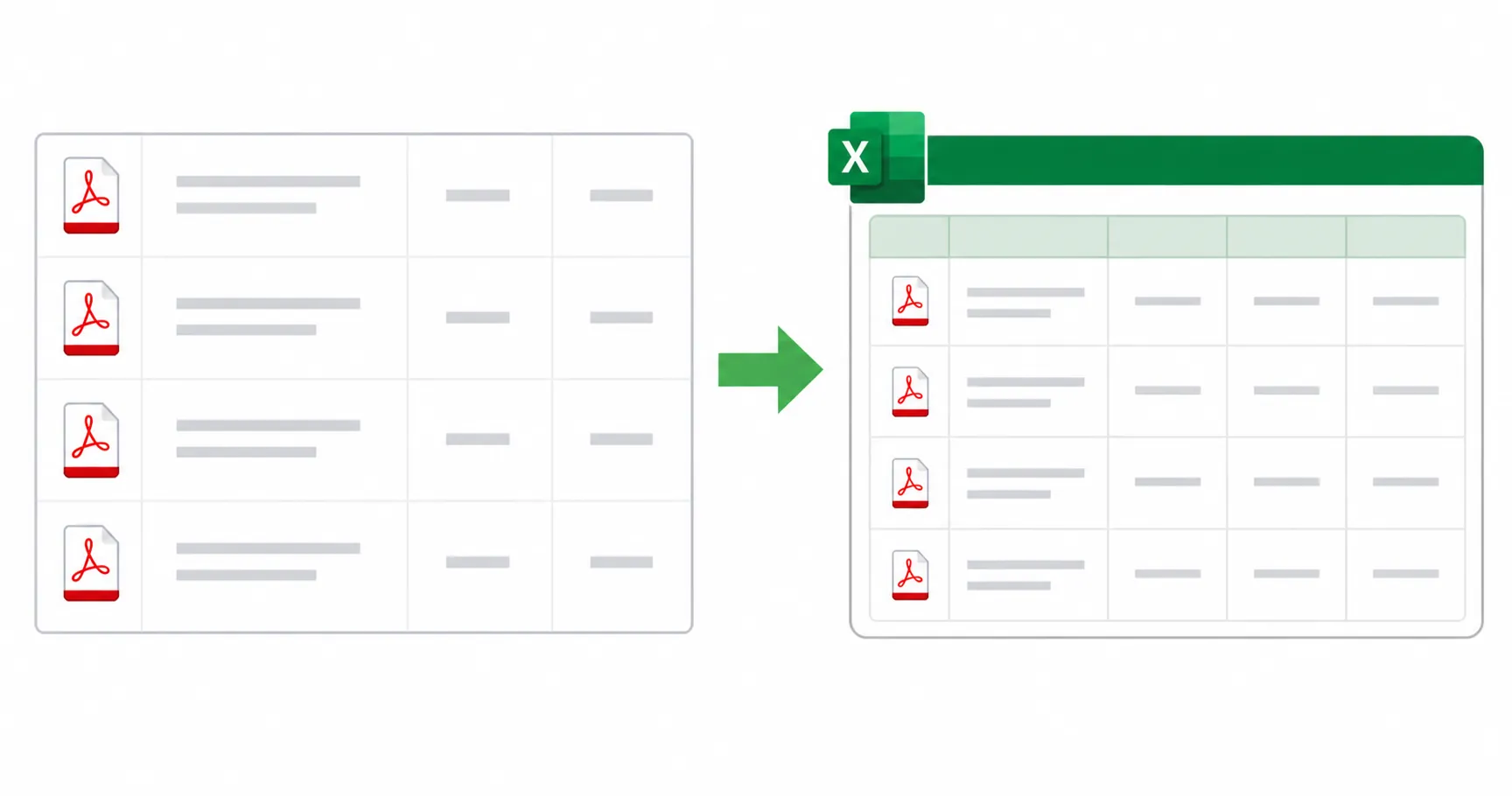
The plug-in allows exporting of document metadata for many files at once without extracting files. The software supports two formats that can be easily imported into any spreadsheet application: text (CSV) and MS Excel XML files. Metadata includes any standard or custom fields such as file name, description, size in bytes, MD5 checksum, creation and modification date/time. If a PDF portfolio was created by Microsoft Outlook ("Convert To Adobe PDF" menu) email application, then each file might have the following metadata fields (specific to email): "Subject", "From", "To", "Cc", "Attachments", "Folder", "Received", "Importance", and "Sensitivity" etc.
Extract metadata

Convert PDF Portfolios For Litigation Support Systems

Export to Litigation Support Systems (Concordance and Summation) ↑top
Convert one or more PDF Portfolios for loading into litigation support systems such as Concordance, Summation, or Relativity. This operation outputs a set of TIFF, Text and PDF files, one output file for each PDF page. All interactive form elements such as buttons, fields, as well as annotations will be automatically flattened before converting to output text, image and PDF files. The plug-in creates separate Summation (*.DII), Opticon (*.LOG) and Casemap load files. 
Export to Summation
Find and Delete Duplicate Pages ↑top
Use this function to find and delete duplicate pages from a PDF document.
The plug-in provides two different methods for identifying duplicate or near-duplicate pages:
  • Comparing visual appearance of the pages as “images”.
  • Comparing page text regardless of its visual appearance.
The first method provides a fast way for detecting pages that look exactly the same or have very small differences. Use it to find pages that are visually identical. This method does not compare any invisible text that may be present on the page. It will not detect any difference between a scanned page with and without OCR applied ("Recognize Text" operation). Similarly, it is not able to detect a white text on a white background.
The second method uses a different approach. It compares page content as text strings with options to ignore case and punctuation. If two pages contain the same sequence of words, then they are considered the same, regardless of the visual appearance and text location on the page. It is possible to use this method to find pages with similar, but not identical content by specifying a maximum allowed difference between two pages (in characters). Note that this method totally ignores any images or graphics that might appear on the page as well as text appearance properties such as font style, size and color.
Deduplicate PDF Files ↑top
The plug-in provides the functionality for  checking a set of PDF files for duplicate and near-duplicate files. The software uses a combination of advanced methods to compare PDF documents and detect files that contain text from other documents. For example, a typical email thread may contain 20 different email replies - the last email containing all previous emails, making the rest of the documents redundant and able to be discarded. Detecting and discarding documents that are redundant allows the user to greatly reduce the number of documents/emails that need to be read during the electronic discovery process. 
Step-by-Step Tutorial: How to de-duplicate PDF files.
Sorting and Filtering ↑top
Record sorting capability allows the user to select a customised order for the embedded files while converting from Portfolio into PDF and other file formats. The plug-in allows you to select only a subset of the embedded files based on either a manual selection or a search query.
Skipping Duplicate Attachments ↑top
The plug-in automatically skips duplicate attachments that are present within a single PDF document. This feature is handy when processing PDF Portfolios created by Adobe PDF Maker from Lotus Notes email. Every email attachment in such portfolios appears to be included twice: once in the header of the email and once in the body. Skipping such files speeds up processing and removes unnecessary duplicates in the output.
AutoDeduplicate for Outlook: Email Deduplication Before eDiscovery Processing ↑top
There is a companion product — a plug-in for classic MS Outlook called AutoDeduplicate — that removes redundant emails directly in Outlook, before they are exported into a PDF Portfolio. It performs an "inclusive email identification" to identify and eliminate this redundancy at the source.
Because the emails are exported into PDF format only after deduplication, AutoPortfolio starts with a smaller, already-reduced set of files to convert and process. This is where the savings come from: less input means less work. In most cases, this reduces overall processing time by 30% or more, along with a corresponding reduction in output file size.
Reporting ↑top
The plug-in automatically generates processing reports in HTML and spreadsheet-ready CSV file formats. The processing report contains detailed information about each input portfolio, lists processed portfolio sub-documents and attachments, and provides file statistics and MD5 checksums. 

Converting EML files into PDF Portfolio

What is EML file format?
It is the standard format used by Microsoft Outlook Express as well as some other email programs. Since EML files are created to comply with industry standard RFC 5322, EML files are often encountered while working with emails from different sources. Emails from Gmail can be downloaded and saved into EML file format.
Conversion into PDF Portfolio Format
The Adobe Acrobat cannot convert EML messages into a PDF file format directly. The AutoPortfolio plug-in provides a function to convert one or more EML files into a single PDF Portfolio file. Each EML message is converted into a separate PDF document that is added to the output portfolio. All email attachments are transferred as file attachments of the corresponding PDF file. Each PDF document entry in the output portfolio is stored with associated metadata. The metadata fields include "To", "CC", "BCC", "From", "Subject", "Date", "Attachments".

Set Custom Document Properties to Multiple PDF Files

Overview
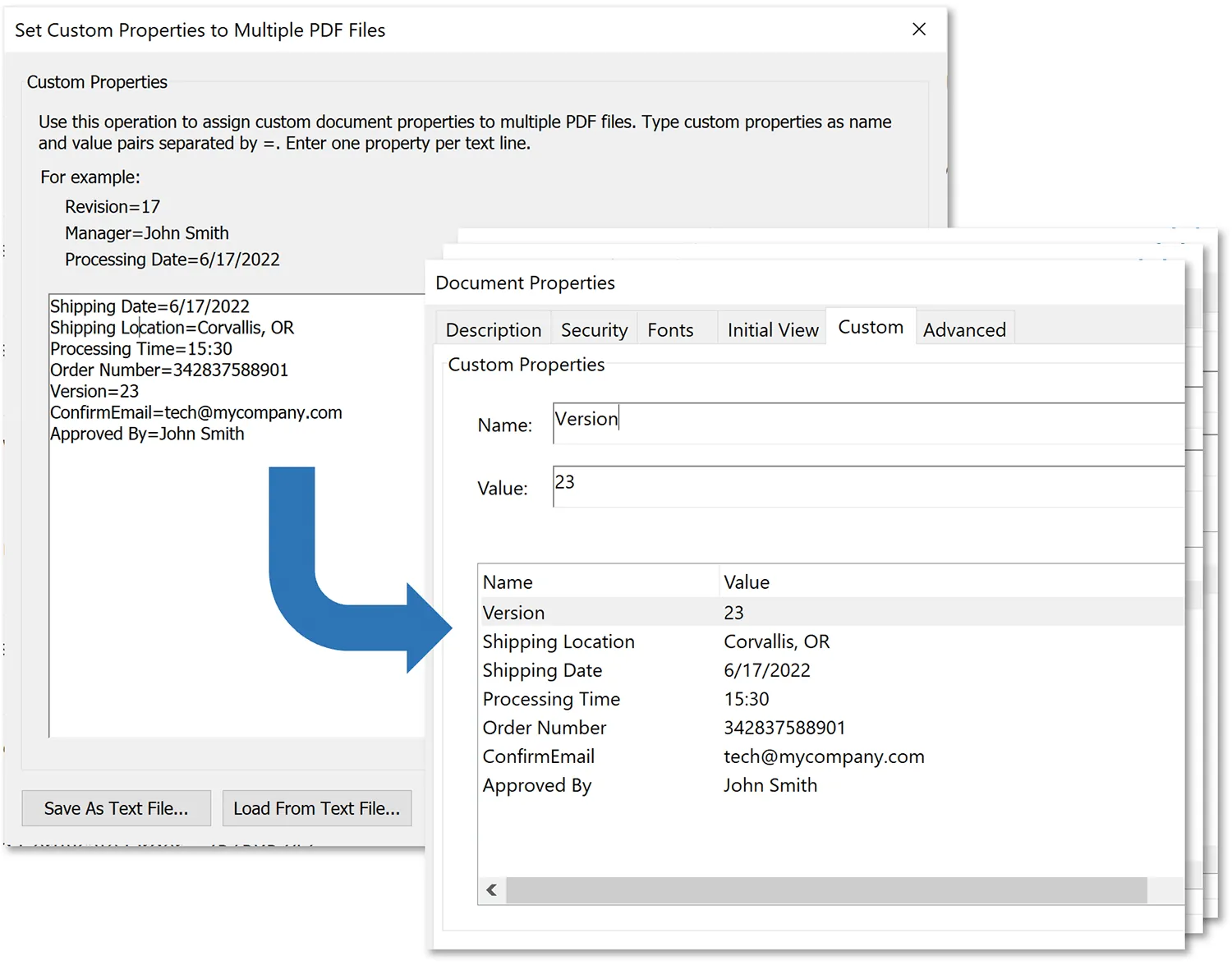
AutoPortfolio provides a way to easily set custom document properties to multiple PDF files at once. Document properties (aka "document metadata") are a common way to attach information to PDF files.
set custom document properties to multiple pdf files

Extract File Properties from Multiple PDF Files

Overview
Extract the following file properties for one or more PDF files or all files in one or more folders:
  • Document filename with extension (for example: MyDocument.pdf)
  • Full path to the document (for example: c:\Data\Projects\MyDocument.pdf)
  • “Title” PDF metadata field
  • “Subject” PDF metadata field
  • “Author” PDF metadata field
  • “Creator” PDF metadata field
  • “Producer” PDF metadata field
  • “Keywords” PDF metadata field
  • PDF Version of the file (PDF file format version the document conforms to. For example: 1.6 )
  • Page count
  • Portfolio (Yes/No) - If corresponding document is a PDF portfolio, then the value is Yes, otherwise No.
  • Number of document-level attachments
  • Form (Yes/No) - If a corresponding document is a PDF form, then the value is Yes, otherwise No.
  • XFA Form (Yes/No) - If corresponding document is an XFA form, then the value is Yes, otherwise No.
  • Number of interactive fields (if a document is a PDF form, 0 otherwise)
  • File size (in bytes)
  • "Modified" date
  • "Created" date
  • Page size (for the first page of the document)
  • Page rotation (for the first page of the document) - possible values:  0 degrees, 90 degrees, 180 degrees, 270 degrees.
  • List of security restrictions. For example: "No document editing", "No printing", "No page inserting", "No bookmark editing" and etc.

Output File Formats
  • CSV (comma-delimited) text file (*.csv) - most widely used spreadsheet format.
  • Tab-delimited text file (*.txt)
  • Microsoft Excel XML Spreadsheet (*.xml)
  • JSON Data File (*.json)
  • HTML report (*.htm) - HTML report that can be viewed in any browser
Here is a sample of the file properties report in HTML format:
File properties extracted as HTML report

Stamp Pages with Filename and Metadata Fields

Overview
Use this operation to stamp pages in one or more PDF documents with corresponding filenames and/or metadata fields such as:
  • File Name
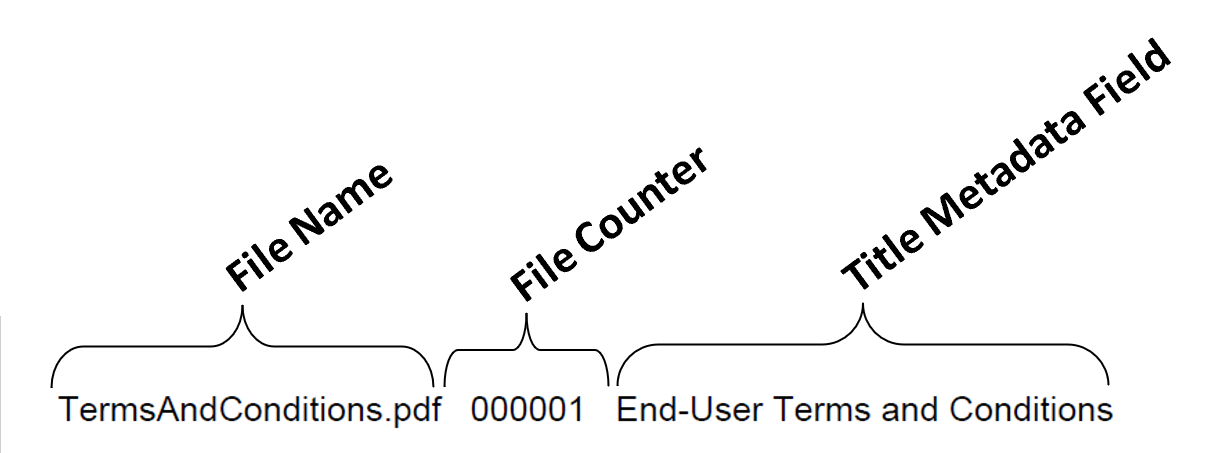
  • File counter (000001, 000002, 000003.. – sequential number of the file):
  • Author
  • Title
  • Subject
  • Keywords
  • Creation Date
  • Modification Date
  • Creator
  • Producer
  • Any Custom Metadata Field
  • Any Custom Text
Text can be placed relative to 5 reference positions on the page: upper left corner, upper right corner, bottom left corner, bottom right corner, and center of the page.
Sample Output
Here is an example of the watermark added to the lower-left corner of the page. Watermark consists of 3 fields: filename, file counter and Title metadata field. The content, style and location of watermark can be fully customized by the user.
Filename and metadata field watermark added to the PDF page

Bates Numbering

What are Bates Numbers? ↑top
Bates numbering (also called Bates stamping) is used in the legal industry as a method to label and identify legal documents, for easy identification and retrieval. A Bates number is a specially formatted, auto-incrementing number (and can be a combination of letters and digits) that is added to every page of the document to uniquely reference it. Nearly all American law firms use Bates numbering during the discovery phase of litigation, to reference and identify documents.
Adding Custom Bates Numbers via a Control File ↑top
Bates numbers can be added to a set of PDF files individually for each input PDF document via the use of a plain-text control file. Each input PDF document can be numbered using a different set of parameters.
Extracting Bates Numbers Into Spreadsheets ↑top
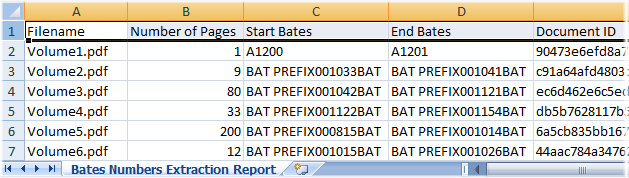
The plug-in provides the functionality for extracting Bates numbers from a selected group of PDF documents (not PDF Portfolios) into a spreadsheet-ready CSV file. The output CSV file can be opened and edited by any spreadsheet application. The following information is extracted for every input PDF document: file name, number of pages, Bates number for a first page, Bates number for a last page, & Document ID. The software extracts Bates numbers that have been previously added to PDF documents using Acrobat's "Bates Numbering" operation.
Bates numbering for multiple PDF files

Customer Testimonials

« It's $199 that is worth its weight in pdf's! I have been using AutoPortfolio plug-in for the past few days and it performs exactly as promised. The attachments are automatically bookmarked behind their parent emails. Bates numbering has been a cinch considering the volume I am working with. For those who use Summation/Concordance, it can format your output to meet your litigation software requirement. I am putting mine in a document library database and this has eliminated some unpleasants step. »
Rhonda Frank
Contract Project Manager/Paralegal
QD Consultation Group, USA
"I have been a customer of EverMap for several years and have found that their products deliver a high degree of quality for a nominal price. In addition, they have one of the best technical support teams in the industry. I have always received highly satisfactory responses in a very short time. I highly recommend this company."
Michael Fero
Assistant to the Treasurer
University of Washington
"I must say, this is the best customer support I have ever experienced. It is far beyond what you can expect. It is quick and very helpful. The software saves me a lot of time for routine work."
Arne Grünert
Advokatfirmaet Grünert AS
Bergen, Norway

Trial Version

Download and evaluate a 30-day unrestricted trial version of the plug-in.

FAQ

Common questions

Can AutoPortfolio combine all emails into a single PDF, or does it create one file per email?

Both options are available. You can choose to output each email and its attachments as its own individual PDF, or combine an entire batch of emails into one large PDF for review.

What happens to email attachments when a PDF Portfolio is converted?

Each attachment is converted to PDF format (if it isn't already) and appended directly behind its parent email, so the full email "family" stays together, just as it would appear in a document production.

Can AutoPortfolio convert non-PDF file attachments, like Word documents, into PDF?

Yes. The plug-in uses the file conversion filters already installed in Adobe Acrobat, so if Acrobat can create a PDF from a given file format, AutoPortfolio can convert it as well. Some formats require the corresponding software to be installed on the same computer, such as Microsoft Word for converting .doc files.

Does AutoPortfolio handle ZIP or MSG file attachments inside emails?

Yes. The plug-in can extract ZIP file attachments and convert all contained files into PDF automatically. It also extracts the content of MSG file attachments (Microsoft Outlook's individual email format) and converts them into PDF on an individual basis, similar to ZIP archive processing.

Can I sort or filter emails before converting them, such as by date or sender?

Yes. Embedded files can be sorted based on metadata such as date received, From, To, or Subject, then merged into a single output file in chronological or any other order. You can also select only items within a specific date range, or use a search to select only documents matching specific text, such as emails from a particular sender or containing a particular keyword.

Can AutoPortfolio prepare documents for litigation support systems like Concordance or Summation?

Yes. AutoPortfolio can convert PDF Portfolios for loading into litigation support systems such as Concordance, Summation, or Relativity, outputting a set of TIFF, text, and PDF files (one per page), along with the corresponding Summation (.DII), Opticon (.LOG), and Casemap load files.

Can AutoPortfolio find and remove duplicate emails or documents?

Yes. The plug-in can detect duplicate and near-duplicate PDF files by comparing document content, which is useful for email threads where a later reply already contains all previous messages, making the earlier ones redundant. It also offers a separate function to find and delete duplicate pages within a single PDF document, either by comparing visual appearance or by comparing the underlying text.

How can I reduce email volume before eDiscovery processing?

Identify and remove redundant emails directly in Outlook, before converting anything to PDF. AutoDeduplicate, (a companion plug-in for classic MS Outlook) performs "inclusive email identification" to filter out redundant messages ahead of conversion, which in most cases cuts overall eDiscovery processing time by 30% or more while also reducing the size of the resulting PDF output.

Is there a way to reduce email volume before converting it to PDF, not just after?

Yes. AutoDeduplicate, (a companion plug-in for classic MS Outlook), performs "inclusive email identification" to significantly reduce the number of emails that need to be converted and processed in the first place, rather than deduplicating after conversion.

Can I convert EML files into a PDF Portfolio?

Yes. Since Adobe Acrobat cannot convert EML files into PDF directly, AutoPortfolio provides a dedicated function to convert one or more EML files into a single PDF Portfolio, converting each message into its own PDF document with attachments preserved and metadata fields such as To, From, Subject, and Date carried over.

Can I extract metadata from a large batch of PDF files without opening each one?

Yes. AutoPortfolio can export document metadata for many files at once without extracting the files themselves, in CSV or Microsoft Excel XML format. This includes standard fields as well as email-specific fields such as Subject, From, To, Cc, and Received, when the portfolio was created from an email export.

Can AutoPortfolio add Bates numbers to a set of PDF files?

Yes. Bates numbers can be added to a set of PDF files individually, with different numbering parameters per file specified through a plain-text control file. The plug-in can also extract Bates numbers that were previously added using Acrobat's own Bates Numbering feature into a spreadsheet-ready file.

Can I stamp each page with the file name or other metadata automatically?

Yes. Pages can be stamped with the file name, a sequential file counter, or metadata fields such as Author, Title, Creation Date, or any custom metadata field or custom text, positioned at any of five reference points on the page.

Is there a trial version of AutoPortfolio available before purchasing?

Yes. A 30-day, unrestricted trial version of the plug-in is available for download and evaluation before purchase.

System Requirements

Platforms: ↑top
Microsoft Windows logo Microsoft® Windows 11/10/Windows 8/Windows Server 2012/2016/2019/2022.
Software: ↑top
Full version of Adobe® Acrobat® software is required (32/64-bit versions 9, X, XI, 2017-2026, DC).  This software will not work with free Adobe Acrobat® Reader®. Batch processing functionality requires presence of Adobe® Acrobat Professional®.
(Adobe Acrobat Product Comparison Chart).

Security Statement ↑overview

  • The Software does not collect, store, nor transmit any user data outside of the user’s computer.
  • All processing is performed locally on the user’s computer.
  • There is no cloud processing or servers involved.
  • The Software can be used in completely disconnected environment with zero network connectivity.
  • There is not any communication back to EverMap servers for any purpose.

No AI Data Collection Statement

Our software does not use artificial intelligence (AI) for analyzing user data. Additionally, user data is never used to train AI models or contribute to any machine learning systems. Your data remains strictly private and protected.